
- This event has passed.
Antiracist Expert Evidence: An Exploration of Racism
Price
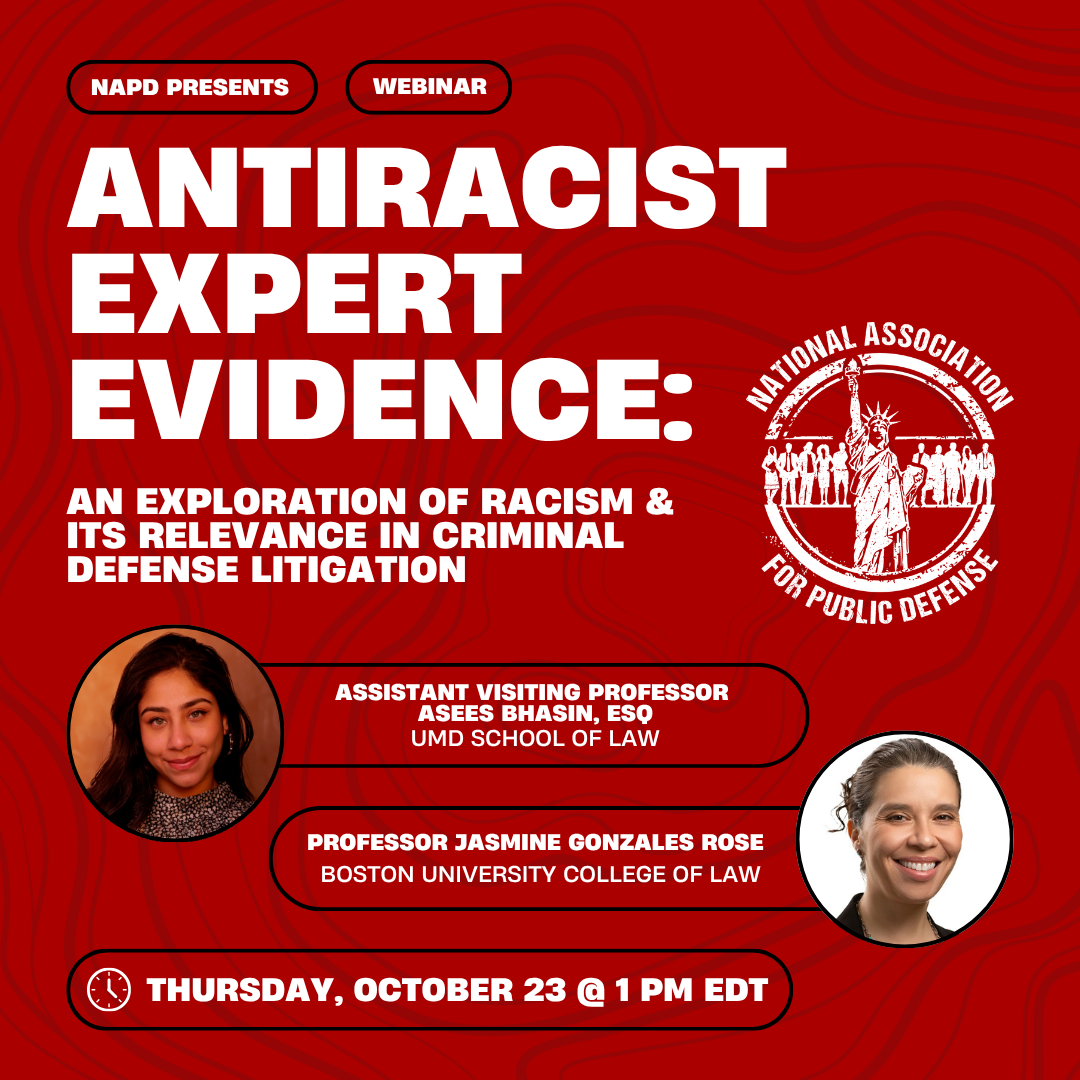
Antiracist Expert Evidence: An Exploration of Racism & Its Relevance in Criminal Defense Litigation
Demonstrating the influence of racism is vital to the practice of criminal defense, yet many attorneys do not know how to prove racism in court. Visiting Assistant Professor Asees Bhasin, Esq. and Professor Jasmine Gonzales Rose, Esq. surveyed over seven hundred criminal-defense attorneys across the United States, and nearly half had never heard of expert witnesses testifying or submitting written reports on racism—what we call “antiracist expert evidence.” This finding would be unremarkable if such experts were unhelpful, but nearly ninety percent of surveyed attorneys expected that antiracist expert evidence would benefit their criminal-defense practices.
In this webinar, they will present the findings of the article, Antiracist Expert Evidence, published in the Yale Law Journal in 2025. This article conceptualizes, categorizes, and instantiates six different expressions, manifestations, or mechanisms of racism relevant to criminal defense: (1) racist affiliations and views; (2) racist language, sounds, and imagery; (3) racial stereotypes; (4) racial disparities; (5) implicit racial bias; and (6) the impact of racism on health and behavior. It also analyzes survey results showing criminal-defense attorneys’ levels of familiarity with antiracist expert evidence, their perceptions of its utility, and the barriers they anticipate to its introduction. This article then examines these barriers and identifies means of overcoming them.
This webinar will cover all of these facets and facilitate a discussion about the use of such evidence in criminal defense practice. You don’t want to miss it!
Questions and concerns? Contact BGT, Webinar Lead, with any questions and/or concerns at Brittanygt@publicdefenders.us.
Professor Jasmine Gonzales Rose is a leading evidence scholar whose work examines how race, language, and racism shape legal proof and influence who can serve as factfinders in the justice system. Rooted in critical race studies and drawing from epistemology and sociolinguistics, her research explores and reimagines evidence law to enhance fairness, accuracy, and equity.
She is Professor of Law and an award-winning teacher at Boston University School of Law, where she currently teaches Evidence, Criminal Law, and LatinXs and the Law, and previously served as Associate Dean for Equity, Justice, and Engagement. Before joining Boston University, she taught for nearly a decade at the University of Pittsburgh School of Law.
A graduate of Harvard Law School, Professor Gonzales Rose clerked for Judge Damon J. Keith of the U.S. Court of Appeals for the Sixth Circuit and Judge Héctor M. Laffitte of the U.S. District Court for the District of Puerto Rico. She serves on the Massachusetts Supreme Judicial Court Advisory Committee on Evidence Law and has led antiracist legal policy initiatives both within academia and the broader community.
She has served on the boards of the American Civil Liberties Union of Greater Pittsburgh and the Abolitionist Law Center, the latter founded by her former students.
Asees Bhasin is a visiting assistant professor of law and Donald Gaines Murray Fellow. She teaches in the first-year Lawyering Program. Her research focuses on critical evidence law, race and the law, reproductive justice, and the intersections between these fields. She is particularly curious about how seemingly neutral rules of procedure contribute to the marginalization of people and communities along race and gender lines.
Previously, Professor Bhasin worked at Boston University, where her research focused on the rules of evidence, and the use of expert witnesses to prove racism in criminal trials. Before that, she was a senior research fellow at the Solomon Center for Health Law and Policy at Yale University where she researched and wrote on health law and racism. She began her legal career as a Georgetown Women’s Law and Public Policy Fellow at the National Partnership for Women & Families in Washington, D.C. where her advocacy was centered on reproductive rights, and maternal and infant health.
Professor Bhasin’s scholarship has appeared or is forthcoming in the Yale Law Journal, the Indiana Health Law Review, the North Carolina Journal of Law and Technology, and the Georgetown Immigration Law Journal. She received a joint JD-LLB degree from Georgetown University Law Center and King’s College London. She was born and raised in New Delhi, India.