Time To Say No

The Public Defender of Marion County (“PDMC”) is a nonprofit public defense office, challenging the legality of Oregon’s case quota system. PDMC and its Executive Director, Shannon Wilson, brought the initial lawsuit against the Oregon Public Defense Commission (“OPDC”), the state agency responsible for administering contracts and funding public defense providers. At the preliminary hearing last November, the judge ruled that certain contract terms were unconstitutional per Article 1, Section 11 of the Oregon Constitution, and void as against public policy. Therefore, the judge ordered it stricken from the PDMC contract.
The focus of this blog is a discussion about Shannon Wilson v. Oregon Public Defense Commission. The heart of this legal action is about protecting the constitutional right to effective representation for public defense clients. We anticipate the results from this litigation will have a national impact on Public Defenders and the clients they serve. Because several of the originalists on the current US Supreme Court have expressed serious doubt about the Gideon v. Wainwright precedent, the authors expressly disavow any claims under the US Constitution and limit the constitutional claims to state constitutions. This way, no favorable decision in a state supreme court can be reviewed by the US Supreme Court.
We know excessive caseloads are a crisis driving inequity in the criminal justice system. Gideon increased the use of public defenders and ensures that all defendants, regardless of their financial situation, have the right to legal representation. The right to legal representation is the right to reasonably effective assistance of counsel pursuant to prevailing professional norms – the ABA Defense Function Standards. (Strickland v. Washington).
The ABA Defense Function Standards were developed over decades by academics, judges, prosecutors, and defenders. They have been cited with approval in hundreds of cases, both state and federal. They are aspirational or describe “best practices” and are not intended to serve as the basis for the imposition of professional discipline. However, these ABA standards “may be relevant in judicial evaluation of constitutional claims regarding the right to counsel.” That is so because the United States Supreme Court has expressly held that these standards are “valuable measures of the prevailing norms of effective representation” (Padilla v. Kentucky, 2010).
The key ABA Defense Standard is Standard 4-6. 1(b), described as an “anchor” for the new National Public Defense Workload Standards (“NPDWS”): “In every criminal matter, defense counsel . . . should not recommend to a client acceptance of a [plea] unless and until an appropriate investigation and study of the matter has been completed [including] discussion with the client and an analysis of the relevant law, the prosecution’s evidence, and potential dispositions and relevant collateral consequences.” (emphasis added).
In 2023, the NPDWS report was released. As part of the national study, researchers conducted a comprehensive review and analysis of 17 state-level public defense workload studies conducted between 2005 and 2022. Not surprisingly, the national study found existing national public defense workload standards are outdated, not empirically based, and inadequate. Prior to the NPDWS, most jurisdictions based on their standards on the antiquated 1973 National Advisory Commission on Criminal Justice Standards and Goals (NAC). The NAC standards are not based on any known methodology. For example, it gave equal weight to a lower-level felony as to a homicide. The NPDWS stressed the importance of a weighted caseload model, calling it the “gold standard for analyzing attorney need.” Each case must be looked at by case type, with the understanding that most attorneys will have a mixed caseload. A weighted model allows for a holistic and accurate view of workload.
Shannon Wilson v. Oregon Public Defense Commission is a reminder that we are all required to uphold the constitution and the ethical rules all lawyers are bound to follow. In the world of public defense, it’s a hard question, but it must be asked.
Is It Time To Start Saying No?
Written by Shannon Wilson and Kawan Clinton
Public defenders, like all lawyers, have ethical rules we must follow. We cannot be lawyers for our clients in name only. We cannot remain complacent with the unethical practices present in public defense. When we cannot perform like effective lawyers, our clients know it. That’s why many call us “public pretenders.” Given the high caseloads and low resources that exist in public defense, we often do the best we possibly can under impossible conditions. But, as the Oregon Supreme Court confirmed, our role as defense counsel is “not merely reactive; it is proactive”. State v. Roberts, 374 Or 821 (2026). There are actions we must affirmatively take in our critical role as defense counsel to protect our clients. In Oregon, the most important action we took began by saying “no” to excessive caseloads.
During my time serving as the Director of PDMC, our organization fought at every turn to uphold ethical practices for public defenders. Choosing to practice in public defense means a lawyer will shoulder the daily tension between being asked to move high volumes of people through the system and the ethical duty to stop, listen, and be a lawyer for the human beings you serve. I’ve learned that the moment a lawyer prioritizes their client’s right to effective representation over the pressures for system efficiency, the entire criminal justice system will push back. A legal system that depends on public defender compliance reacts brutally when we stand up and hold ethical boundaries. In response to our saying no to excessive and unethical caseloads, several local judges wrote letters stating that I was “untrustworthy,” threatened me with bar complaints, and even questioned my fitness as a lawyer. Past board members directed me to “shut up about ethics” and that my job was to “just put lawyers as*** in the seat at counsel table.” During one court hearing while discussing the ethical obligations of public defenders, the judge refused to listen to our ethical concerns and told me to sit down or else she would take me into custody.
When choosing to center legal responsibilities to your clients over sycophantic public defense practices, intense systemic consequences are guaranteed to follow. And yet, it is during these exact moments when these pressures hit the hardest that a public defender’s ethics matter the most.
Public Defense in Progressive Regressive Oregon
In 2019, the Oregon Legislature funded the 6th Amendment Center to conduct an analysis of the state’s public defense delivery system. The study found that Oregon’s pay-per-case funding model incentivized lawyers to take on high volumes of cases instead of funding lawyers to provide effective assistance of counsel. In 2021, the Legislature substantially expanded the responsibilities of OPDC. They directed OPDC to adopt policies ensuring public defense compensation, resources, and caseloads aligned with national and regional best practices, and to adopt a statewide workload plan.
In 2023, the Legislature enacted Senate Bill 337, requiring OPDC to develop, adopt, oversee, and enforce policies ensuring that public defense providers deliver effective assistance of counsel consistent with the Oregon and United States Constitutions. “The workload of appointed counsel must be controlled to permit effective representation. Economic disincentives or incentives that impair the ability of appointed counsel to provide effective assistance of counsel must be avoided.” This legislative mandate was unambiguous: Oregon must move on from arbitrary caseload metrics, abolish the pay-per-case funding model, and adopt a statewide workload plan grounded in the realities of ethical representation.
Sadly, just two years later, public defense in Oregon took a massive step backwards. Despite the findings from the 6th Amendment Center, the Oregon Workload Project, and OPDC’s adoption of the National Public Defense Workload Study (NPDWS), Oregon returned to the pay-per-case system. Due to judicial, legislative, budgetary, and executive pressure, Oregon resorted to using a case quota system based on the 1973 National Advisory Commission on Criminal Justice Standards and Goals (NAC). By doing so, Oregon abandoned constitutional public defense standards. In 2025, the pay-per-case model was reinstated, though under a different name. In a rather embarrassing turn, Oregon created a public defense caseload quota system.
Saying “No”
During the pandemic, many cases were slower to resolve, and workload conditions intensified. Our clients’ medical and behavioral health needs increased. Our most seasoned defenders became overwhelmed and were mentally reaching their breaking point. Experienced lawyers left public defense. New lawyers entering public defense work were becoming scarcer. I discovered that fundamental attorney tasks such as completing independent investigations, providing sufficient client communication, and conducting critical legal research, were frequently neglected due to high caseloads. Attorneys only had enough time to bounce from one court hearing to another and one quick client meeting to another. They did not have the capacity to conduct actual legal work.
In May of 2022, public defense leaders in Oregon began holding regular meetings with the courts and public safety stakeholders to address the shortage of public defenders and the growing list of people facing charges without assigned counsel. During these meetings, we tried to educate judges about the damaging impact excessive caseloads had on the attorneys at PDMC. We shared that high caseloads were the primary reason cited for public defender burn out and stress-related medical conditions.
PDMC worked with Moss Adams to publish the PDMC Workload Analysis using the NPDWS standards and the Oregon Workload Project’s anticipated attorney hours. The findings showed that PDMC was deficient by eleven attorneys for the current number of clients. We could not deny the data about our practice – public defenders seriously lacked the time and attorney resources necessary to meet their basic ethical obligations. Instead of making excuses for our well-meaning shortcomings and continuing the typical triage approach to clients’ cases, PDMC admitted we had more clients than we could ethically handle. However, our local judges dismissed our expertise and the shortage of public defense attorneys. Due to the growing number of unrepresented people, the court decided to force appoint PDMC attorneys above our objection. During the 11-month period following judicial forced appointments, PDMC experienced a 60% turnover of our attorney workforce.
The onslaught of court forced appointments required PDMC attorneys to file several motions to withdraw from representation. Prior to filing these motions, we spoke with newly appointed clients about our limited capacity and ethical duty to withdraw. It was difficult to have conversations about a public defender’s inability to provide effective representation, but our clients’ responses surprised us. They did not respond with anger or confusion. Clients overwhelmingly responded with understanding and appreciation. They already knew public defenders were too overwhelmed to truly work their case. Not a single client objected to our motions to withdraw from representation.
For the first time in Oregon history, public defenders were refusing to take on new clients. PDMC objected on the record to new client appointments. We also attached the recent PDMC Workload Report as an offer of proof in support of the objections. Instead of reviewing the data and listening to public defenders’ experiences, some local judges ridiculed PDMC attorneys calling them “lazy,” “weak,” or “liars.” Under the weight of these judicial attacks, I watched passionate, hard-working public defenders drain to a silhouette of the advocates they once were.
We were never granted a factual hearing at the trial level, so we filed a mandamus petition with the Oregon Supreme Court. OPDC filed an amicus brief in support of PDMC, emphasizing the Maximum Attorney Caseload (“MAC”) terms used in the public defense contracts were truly a maximum number of cases that public defenders could not exceed. OPDC explained in their legal brief that the MAC was designed as a temporary stopgap while the legislatively funded studies (6th Amendment and ABA Oregon Project) on public defense delivery systems and workloads were completed. MAC was never intended to be used as a performance metric for lawyers or funding trigger. OPDC’s position was clear – public defenders were required to decline new cases when accepting them would violate their ethical obligations. For a time, OPDC cared about the ethical duties of public defenders. But as the list of unrepresented people grew and political pressure mounted from every branch, OPDC’s constitutional integrity and independence began to collapse. Unfortunately, our mandamus petition was dismissed as moot when the attorney assigned to this client accepted employment with OPDC and resigned.
Oregon’s MAC Caseload Quota
Following the mandamus and the publication of the NPDWS, OPDC initially moved forward with supporting ethical public defense practices and adopted the NPDWS standards for Oregon. OPDC developed the detailed plan to implement these standards over a six-year period (“the Six-Year Plan”) and detailed the budget needed to deliver effective representation for public defense clients. Legislators and the Governor were shocked by the real cost necessary to adequately fund public defense and quickly rejected the budget for the Six-Year Plan to implement the NPDWS. OPDC was then directed to pivot and then approved contracting policies requiring public defenders to reach 85–90% of the MAC caseload or face a loss of funding. The 2025 Oregon legislative session ended with a budget note holding back $22 million from OPDC unless the agency submitted a report of all public defenders operating below 90% of MAC (described in this report as a mandated attorney caseload). Although that budget note required just the report, this legislative message marked the end of MAC operating as a maximum attorney caseload. Instead, MAC became a minimum caseload quota.
The conflict between the MAC quota and ethical defense work was raised repeatedly by public defense leaders, judges, and even members of the OPDC commission. Some Commissioners acknowledged the MAC quota was not the correct standard for Oregon’s public defense. However, OPDC believed the legislative budget constraints meant Oregon public defense was “stuck with MAC” for the foreseeable future. The Public Defenders of Oregon (a nonprofit group of public defense leaders) urged OPDC to explore concrete alternatives to the MAC quotas. PDO proposed using a time-based case crediting model, case credit systems proportional to the actual work, and the adoption of a statewide workload model grounded in NPDWS. All proposed alternatives were dismissed by OPDC and Oregon’s legislature.
Under the new MAC contracts, public defenders were now required to meet a quota at all costs. Public defenders were expected to absorb monthly caseloads from other attorneys on top of their own monthly quota. For example, if an attorney at a public defense office reached their maximum ethical capacity or was out on medical leave, other public defenders were required to cover that attorney’s existing caseload, plus new cases to meet that attorney’s MAC quota numbers. If other attorneys could not do so, the public defense office would lose funding for attorney positions.
An attorney’s allowable hours under a MAC quota, does not account for the basic time needed to conduct fundamental attorney tasks such as:
· Conducting discovery review, including watching hours of video and working with digital evidence
· Performing an independent defense investigation and completion of witness interviews
· Developing mitigation, gathering evidence, and conducting research
· Accounting for client interpretation needs and services
· Understanding and planning for client mental health and medical needs and necessary services
· Providing competent legal research and writing
· Diligent preparation for client trials even when cases later resolve
· Working with experts and understanding the complexities of modern litigation practice
The MAC quota allows an attorney only 5.26 hours on average to complete a misdemeanor case, the total time allowed from client appointment to completion. Beyond this absurdity, the limited 5.26 hours is the best possible average (if at all) for the mythical attorney who begins a contract year with zero clients. The MAC standard completely ignores the existence of open caseloads and the actual time required to provide effective legal representation.
Under the MAC, attorneys are incentivized to spend less time on each client matter, neglecting the basic tasks of effective representation. MAC creates a direct conflict with a lawyer’s obligations under Oregon RPCs 1.7, 1.16, and 5.1. Under Oregon RPC 8.4 and Oregon Formal Opinion 2007-178, attorneys cannot 1) contract away their client responsibilities nor 2) induce another lawyer to do so. Yet the MAC quota contract does exactly that.
The PDMC Public Defense Ethics Project
Anticipating Oregon’s shift away from the NPDWS workload standards and unconstitutional return to the pay-per-case model, PDMC began developing the Public Defense Ethics Project (“PDEP”), in 2024. The PDEP project uses workload analysis tools grounded in the NPDWS standards. PDEP is designed to help public defenders assess their ethical capacity using empirical data rather than Oregon contract quota numbers. PDEP documents and serves as a guide for PDMC’s public defense workload policies and practices. It is a strong attempt to remediate reasonably foreseeable ethical violations created under Oregon’s quota system. At an operational level, all cases are coded according to the NPDWS charge categories according to their crime seriousness level and potential prison exposure. Each case calculation uses the average number of attorney hours associated with different case types from the NPDWS. In addition to NPDWS standards, PDMC attorneys are also trained in ethical time keeping practices and learn how to evaluate their ongoing workload. PDEP includes analysis of, inter alia, attorney level of experience, client caseload mix, amount of discovery volume, the client custody status, individual client needs, availability of defense experts and other defense resources, and an attorney’s upcoming trial schedule. Under PDEP, there are gross disparities between the allowable attorney hours under MAC and the reasonable amount of attorney hours needed to provide competent, diligent, and effective representation.
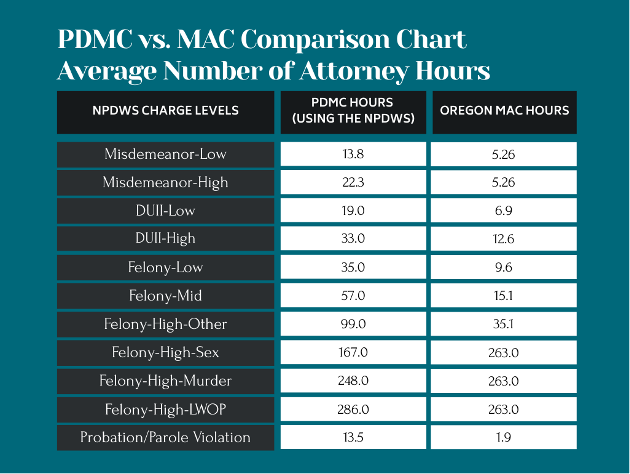
In September 2025, when OPDC offered a contract to PDMC, we were ready, willing, and able to sign, so long as the MAC case quota requirements were removed. We tried to negotiate and asked that MAC remain as a caseload ceiling. We explained that PDMC lawyers must be permitted to prioritize their ethical duties to clients and allowed to exercise ethical shut offs when required under the rules. When OPDC refused to remove the MAC quota, we sought an hourly contract as an alternative. Each request was denied by OPDC. We were given the choice to sign the contract as is or close our doors. At no point during these contract negotiations did OPDC ever deny that the MAC quota caused ethical violations. Nor did OPDC claim the MAC was an appropriate standard. The explanation for MAC remained consistent – OPDC believed that legislative budget directives required enforcement of a quota contract, even when MAC contradicted the ethical obligations of public defenders. OPDC’s position was firm – “MAC would be the only standard used for public defenders”, Oregon rules of ethics be damned. There was no question … I could not ethically sign a contract with those terms.
According to Oregon’s ethical rules and OSB Formal Opinion 2007-178, a supervising attorney cannot contract another attorney for unethical practices. The MAC contract would require PDMC to prioritize quota compliance over ethical workloads. Under Oregon RPC’s, PDMC attorneys and clients would be exposed to reasonably foreseeable ethical violations. As the Director of PDMC and a supervising attorney, I am personally bound by ORPC 5.1 to implement reasonable measures to ensure lawyer compliance with the ORPCs and to take remedial action to prevent or address violations. There is no exception. The Oregon State Bar made it clear that when a contract requiring excessive caseloads for public defenders is offered, I cannot sign it.
Taking Necessary Legal Action
By refusing to sign this contract, OPDC blocked PDMC from taking in new clients and cut our funding for any ongoing public defense work. By prioritizing our ethical duties, I risked the livelihood of nearly 50 PDMC employees. This happened right before the holiday season. During the time when healthcare subsidies were going away, I risked losing health insurance for my employees and their families. Not only were people’s homes and families on the line, but their ability to continue working as a public defender was at risk. We were forced to lay-off provisionally licensed attorneys, investigators, and support staff. With the lack of state funding came unbearable instability. Half of our attorneys interviewed with and took positions at offices that signed the MAC contracts. The ethical decision PDMC had to make was clear, but it was not an easy decision act on. Regardless of the real and personal consequences, PDMC’s ethical duties to our clients could not yield to a quota.
For ethical lawyers aware of conflicts, complicity and silence are not an option. Even when challenged by a loss of employment and livelihood, public defenders must remain steadfast in their ethical duties. Under the most difficult circumstances, we must trust ethics to guide us. And as grueling as the circumstances seem, we must uphold ethical obligations and professional responsibilities as lawyers in public defense … even if that means saying “no” to a contract and legally challenging the entire state public defense system.
On September 30, 2025, PDMC filed a lawsuit challenging the unethical and unconstitutional standards and terms in Oregon’s MAC quota contracts. PDMC filed a preliminary injunction to stop OPDC from using unethical quotas and offering financial incentives to cover up the shortage of Oregon public defenders. During our preliminary hearing on November 14, 2025, Judge Michael Wetzel ruled in our favor, finding that contract terms in dispute were unconstitutional. This initial win was monumental. It was the first time an Oregon court issued a favorable ruling on ethical caseloads for public defenders.
The full trial challenging Oregon’s public defense standards and contracts begins on February 19, 2026. This trial will determine whether Oregon must address the public defense problems it uncovered with the 6th Amendment Center Evaluation and the Oregon Project Analysis. The court will decide whether a pay-per-case public defense model will be allowed to continue to cover up Oregon’s unrepresented crisis and ignore the ethical obligations of public defenders. Ultimately, this decision will establish whether those who cannot afford a lawyer are guaranteed effective representation or whether an exception exists for Oregon’s public defense.
Saying “no” to OPDC’s contract quota scheme is not about politics or legislative budgets. Saying “no” is about protecting the right to effective assistance of counsel. It is about doing what it takes to fulfill our professional responsibilities without exception. It is about saying “no” to compromising those foundational principals and standards for clients who cannot afford an attorney. It is a public defender’s ethics in action, and it is worth the cost.
Conclusion
So, it’s time to ask yourself, if I am working in conditions where I cannot perform as real lawyer, is it time to start saying no? When asked or incentivized to ignore my duties to my individual clients, can I say no? Will I be complacent when pressured by judges, governors, or lawmakers, or will I stand up and say no?
The Oregon lawsuit relies on the NPDWS evidence-based standards and attorney hours to challenge the rampant inequities that plague our criminal justice system. Caseload and workload are not the same. It’s time we stopped treating them as if they were. NPDWS reflects the required work of attorneys in the current state of criminal defense.
The National Public Defense Workload Study (NPDWS) set out to create new national standards for public defender workloads. What the study provides is essential for adequate funding and staffing so public defenders can competently represent their clients per the Rules of Professional Conduct and as guaranteed by the Sixth Amendment of the U.S. Constitution and the Oregon Constitution. We know that public defense practice has changed significantly with the rise of digital discovery, forensic evidence, and other technological advancements such as body worn cameras. NPDWS reflects these changes and the expanded the obligations for public defenders, including independent defense investigation and advising clients on immigration risks and collateral consequences. NPDWS reliably demonstrates the average amount of time needed for lawyers to fulfill their foundational ethical duties and responsibilities to clients.
NPDWS presents the core ethical principles and actions essential to guaranteeing the right to effective counsel. Now, public defenders can rely on evidence-based standards to stand up and say –
No, I will not violate my clients’ right to effective representation.
No, I will not compromise my professional ethics and practice responsibilities.
No, I will not be a public pretender.
I will say no to protect my sworn role as defense counsel, essential to the integrity of the entire criminal justice system, without exception.